
How Big Are Acupuncture Needles
Acupuncture is an ancient healing practice that has been used for thousands of years to treat a variety of health conditions. One of the most common questions people have before their first acupuncture treatment is: how big are acupuncture needles? If you're curious about the size of these needles, how they work, and why their dimensions matter, you've come to the right place. In this blog, we'll explore everything you need to know about acupuncture needle sizes and their significance in acupuncture therapy.
Understanding Acupuncture Needles
So, what is acupuncture at its most basic level? It's the insertion of thin, solid needles — typically made from stainless steel — into specific acupuncture points on the body, known as acupoints. Unlike hypodermic needles used for injections, acupuncture needles are much finer and designed to gently stimulate these points as part of traditional Chinese medicine acupuncture. Their size and thickness play a crucial role in ensuring a comfortable and effective treatment [1].
How Big Are Acupuncture Needles?
Acupuncture needles come in a variety of sizes, but they are generally much smaller than most people expect.
Here's a breakdown of their dimensions:
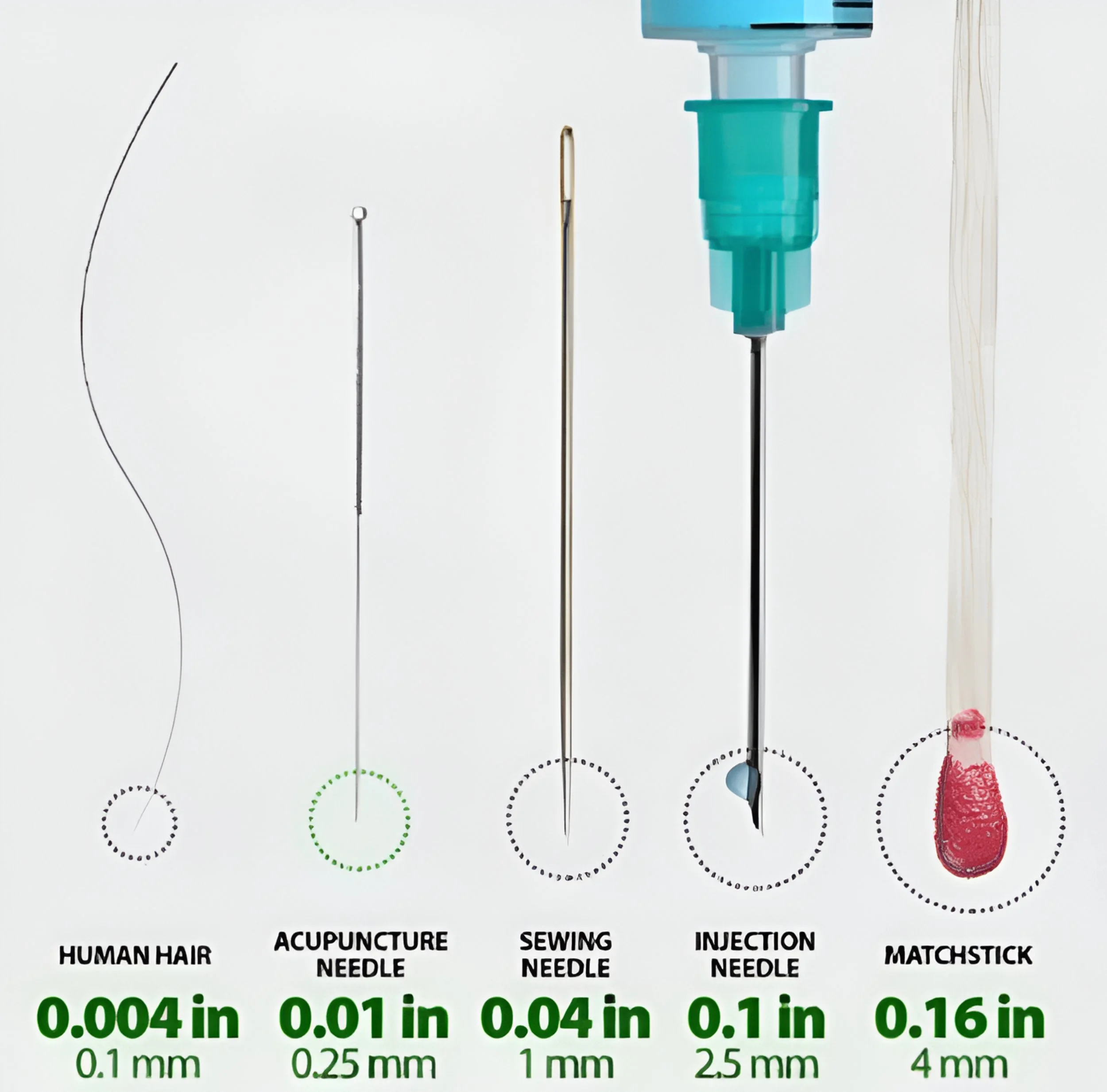
Length
Acupuncture needles typically range from 0.5 inches (15 mm) to 3 inches (75 mm) in length. The length used depends on the area of the body being treated. For example:
Shorter needles (0.5–1 inch) are used for areas with less muscle or fat, such as the face or hands [2]
Longer needles (1.5–3 inches) are used for thicker areas like the back or buttocks — commonly the case in acupuncture for back pain treatment [3]
Diameter (Thickness)
The thickness of acupuncture needles is measured in gauges. The higher the gauge number, the thinner the needle. Most acupuncture needles range from 32 gauge (0.25 mm) to 36 gauge (0.16 mm).
For comparison, a standard hypodermic needle is around 22–25 gauge, making acupuncture needles significantly thinner [4].
Why Size Matters
The size of an acupuncture needle is carefully chosen based on the treatment goals and the patient's comfort. Here's why size matters:
Precision Thinner needles allow for precise insertion into acupuncture points, ensuring accurate stimulation of the targeted area [5].
Comfort The ultra-thin design of acupuncture needles minimizes discomfort during insertion. Many people report feeling little to no pain [6].
Depth of Insertion Longer needles are used for deeper acupoints, while shorter needles are ideal for superficial points [7].
Patient Sensitivity Thinner needles are often preferred for patients who are new to acupuncture, have a low pain tolerance, or are seeking acupuncture for anxiety or acupuncture for stress relief, where a gentler approach is often prioritised [8].
Common Acupuncture Needle Sizes and Their Uses
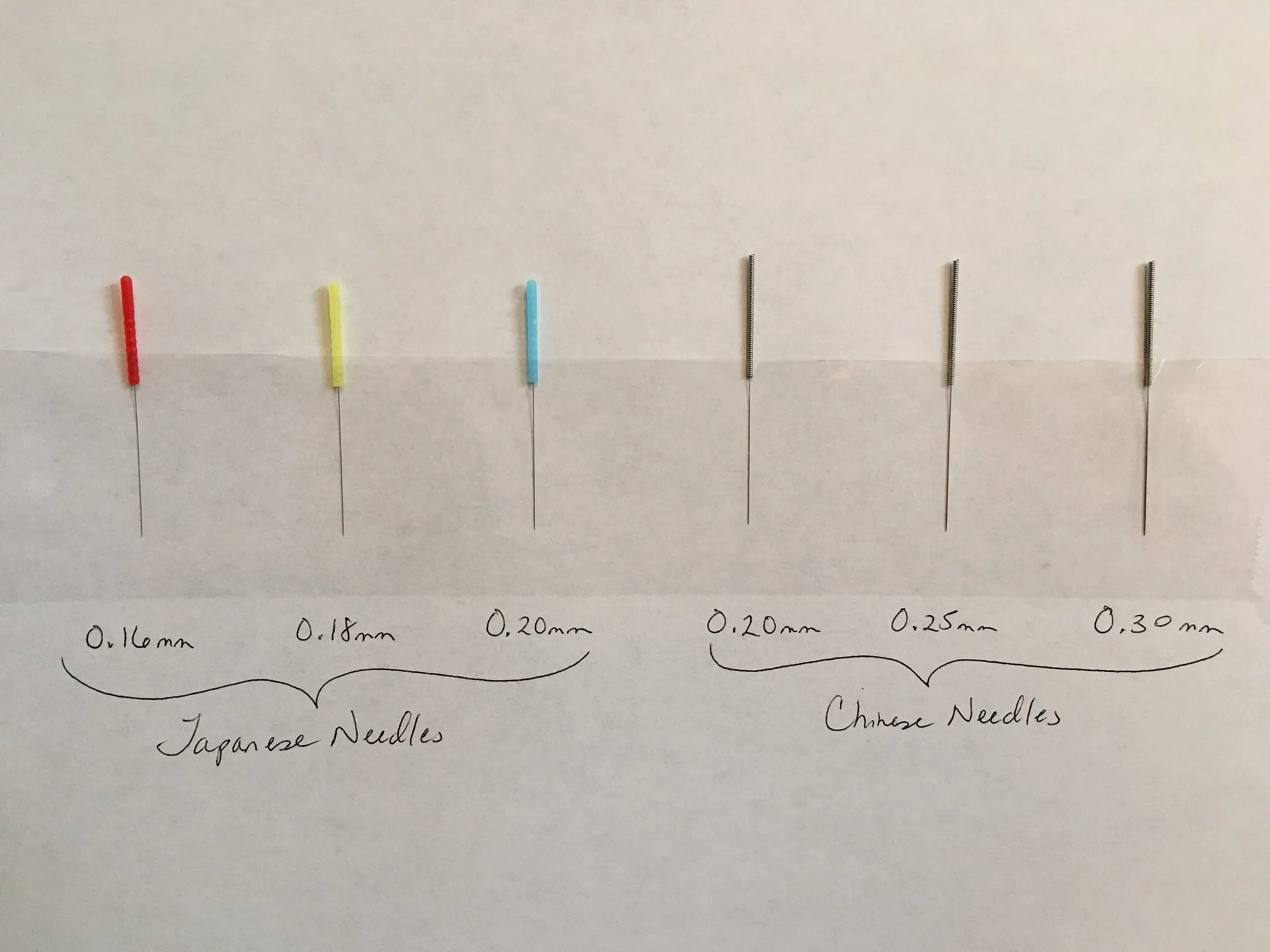
Here's a quick guide to the most commonly used acupuncture needle sizes and their applications:
0.5–1 inch (15–25 mm), 36 gauge (0.16 mm) Ideal for facial acupuncture, ear acupuncture, and treating sensitive areas [9].
1–1.5 inches (25–40 mm), 34 gauge (0.18 mm):
Commonly used for hands, feet, and other areas with moderate muscle or fat [10].
1.5–3 inches (40–75 mm), 32 gauge (0.25 mm) Best for thicker areas like the back, thighs, and buttocks, where deeper insertion is required — typically the sizing used for acupuncture for chronic pain treatment and acupuncture for back pain Sydney patients often ask about [11].
Dry Needling vs Acupuncture Needles
Because both use fine needles, people often ask about dry needling vs acupuncture. The needles themselves are often similar in gauge, but the intent differs: dry needling targets isolated muscle trigger points using a Western physiotherapy framework, while acupuncture needles are placed at specific acupuncture points selected through traditional Chinese medicine diagnosis, aiming to influence broader patterns like Qi and Blood flow rather than a single muscle.
Are Acupuncture Needles Safe?
Yes, acupuncture needles are safe when used by a licensed acupuncturist. They are:
Sterile Disposable and single-use to prevent infection [12].
Flexible Designed to bend slightly, reducing the risk of breakage [13].
Minimally Invasive Their thin size ensures minimal tissue damage [14].
Reported acupuncture side effects are typically limited to minor bruising or brief tenderness at the needle site — rare when treatment is delivered by professional acupuncture services with proper training and hygiene standards.
Does Acupuncture Work, Regardless of Needle Size?
So, how big are acupuncture needles? While they vary in length and thickness, they are always much smaller and thinner than standard medical needles. Their precise sizing ensures effective acupuncture treatment with minimal discomfort, making acupuncture a safe and gentle option for holistic acupuncture care. Does acupuncture work regardless of which size needle is used? Needle size is chosen for comfort and depth, not effectiveness — the acupuncture benefits reported across pain relief, stress relief, and general wellness apply whether a session uses the shortest facial needles or the longer needles used on the back.
Conclusion
If you're considering acupuncture, rest assured that the needles are designed with your comfort and safety in mind. Always consult a licensed acupuncturist to ensure the best results for your
specific needs — whether that's acupuncture for pain relief, acupuncture for fertility, or general acupuncture for wellness.
Book Your Acupuncture Consultation in Brisbane and Beyond
Curious to experience it for yourself? Start with an acupuncture consultation with a registered acupuncturist Australia can vouch for — always an AHPRA registered acupuncturist, ideally affiliated with the Australian acupuncture association.
Based in Brisbane, The Gentle Needle Guy also welcomes enquiries from patients searching for an acupuncture clinic Sydney, acupuncture clinic Melbourne, or acupuncture clinic Perth option, and offers:
professional acupuncture services with a full range of needle sizes tailored to your comfort
affordable acupuncture services and transparent session pricing
same day acupuncture appointment availability
flexible acupuncture appointment booking, in person or online
eligibility checks for an acupuncture Medicare rebate Australia (with referral) or private health fund acupuncture Australia cover
If you're searching "acupuncture clinic near me Australia" or "acupuncture practitioner near me," look for a Chinese medicine clinic Australia-wide that takes needle comfort as seriously as clinical results. Book your acupuncture appointment Australia-wide today.
References
National Center for Complementary and Integrative Health (NCCIH). (n.d.). Acupuncture: In Depth. Retrieved from https://www.nccih.nih.gov/
World Health Organization (WHO). (2003). Acupuncture: Review and Analysis of Reports on Controlled Clinical Trials. Retrieved from https://www.who.int/
Acupuncture Today. (n.d.). Understanding Acupuncture Needles. Retrieved from https://www.acupuncturetoday.com/
Journal of Acupuncture and Meridian Studies. (2018). Standardization of Acupuncture Needles for Clinical Use. Retrieved from https://www.jams-kpi.com/
White, A., & Ernst, E. (2004). A Brief History of Acupuncture. Rheumatology, 43(5), 662-663.
Lao, L., Hamilton, G. R., Fu, J., & Berman, B. M. (2003). Is Acupuncture Safe? A Systematic Review of Case Reports. Alternative Therapies in Health and Medicine, 9(1), 72-83.
Deadman, P., Al-Khafaji, M., & Baker, K. (2007). A Manual of Acupuncture. Journal of Chinese Medicine Publications.
MacPherson, H., Thomas, K., Walters, S., & Fitter, M. (2001). The York Acupuncture Safety Study: Prospective Survey of 34,000 Treatments by Traditional Acupuncturists. BMJ, 323(7311), 486-487.
Cheng, X. (2010). Chinese Acupuncture and Moxibustion. Foreign Languages Press.
Birch, S., & Felt, R. (1999). Understanding Acupuncture. Churchill Livingstone.
Stux, G., Berman, B., & Pomeranz, B. (2003). Basics of Acupuncture. Springer.
U.S. Food and Drug Administration (FDA). (2020). Regulation of Acupuncture Needles. Retrieved from https://www.fda.gov/
Park, J., White, A., & Ernst, E. (2001). Efficacy of Acupuncture as a Treatment for Tinnitus: A Systematic Review. Archives of Otolaryngology–Head & Neck Surgery, 127(8), 489-492.
Witt, C. M., Pach, D., Brinkhaus, B., Wruck, K., Tag, B., Mank, S., & Willich, S. N. (2009). Safety of Acupuncture: Results of a Prospective Observational Study with 229,230 Patients and Introduction of a Medical Information and Consent Form. Forschende Komplementärmedizin, 16(2), 91-97.